
BLDC motor controller
Three-phase drivers for brushless DC motors, with the power stage, current sensing, position feedback and protection.
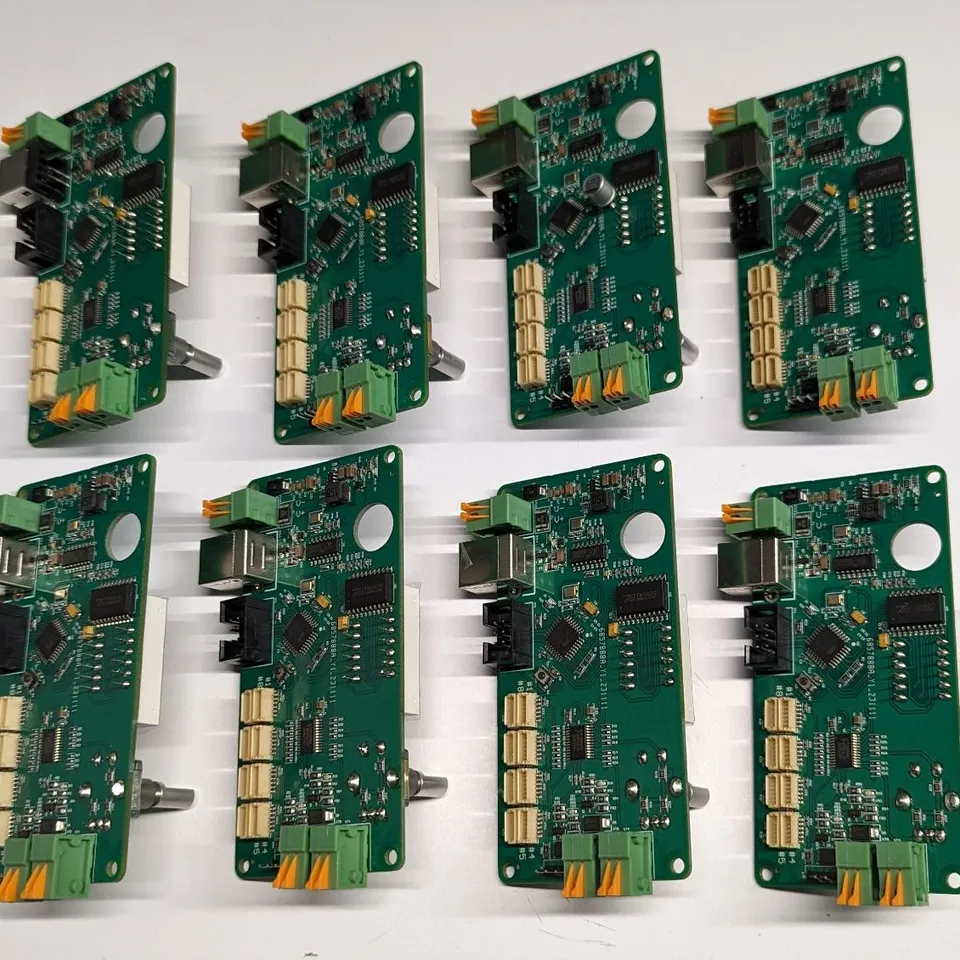
Motor controller design joins power electronics, sensing and real-time firmware on one board. We design drivers and controllers for machines, automation and equipment builders, from the power stage to the control loop, and test them with the motor and load they will run in service.
Three-phase drivers for brushless DC motors, with the power stage, current sensing, position feedback and protection.
Drivers with current control and microstepping for positioning axes, dosing and feeding mechanisms.
Closed-loop control of position or speed from encoder or sensor feedback, commanded over a fieldbus or digital inputs.
H-bridge drivers for actuators, pumps and fans, with current limiting and braking.
Boards that coordinate several axes, read limit switches and sensors, and report to a PLC or supervisor.
The power stage decides whether a controller survives its first stall. We size MOSFETs, gate drivers and current shunts for the peak current, not only the rated one, and lay out the power loop to keep switching noise off the control circuit. Heat is planned from the start: copper area, thermal vias and the path to the enclosure or a heatsink.
Protection is designed in:
The right feedback depends on the job. Hall sensors suit fans and pumps that start under light load. Incremental or absolute encoders suit positioning axes and servo work. Shunt resistors or current transformers measure phase and supply current for both control and protection. We choose the sensors with you, design their input circuits, and check their signals for noise with the power stage running, not only on a quiet bench.
Control loops, commutation, ramps and fault handling run on STM32 and similar microcontrollers, with timing measured on the real board. Commands arrive over CAN, RS-485 with Modbus RTU, step and direction inputs, or analog setpoints, and the controller reports state, faults and counters to the machine. See embedded firmware.
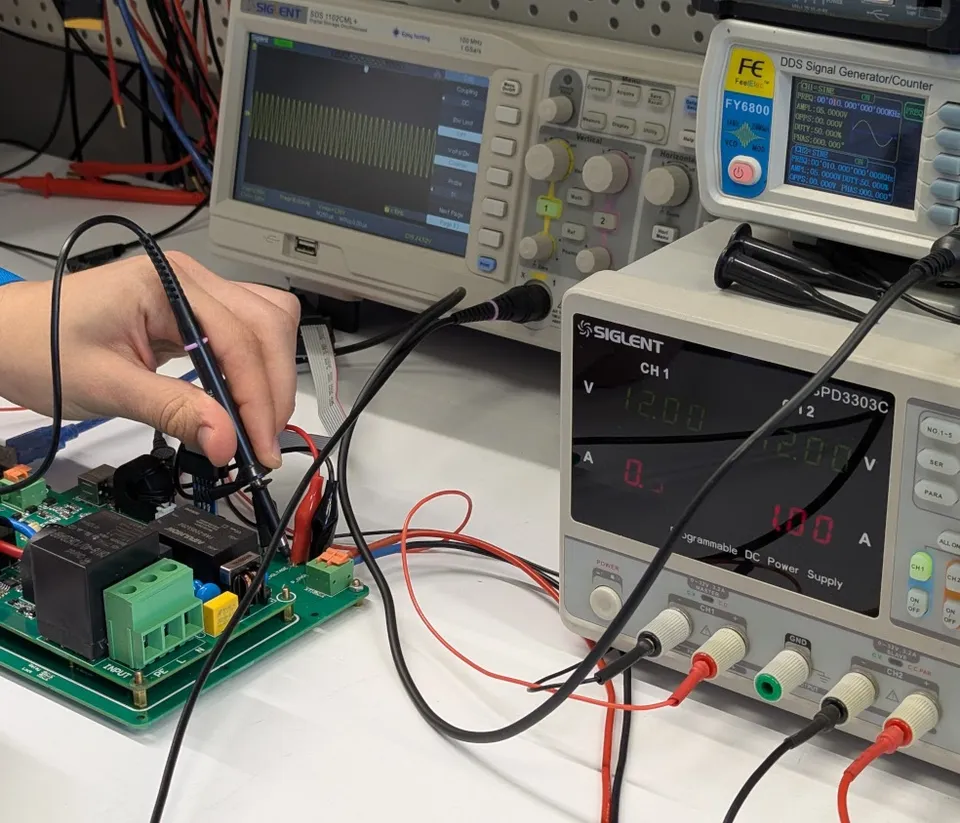
A motor controller is only proven under load. Prototypes are tested on the bench with the customer's motor or an equivalent, through start-up, acceleration, stall, reversal and overload, with currents and timings recorded on the oscilloscope. Production units are checked on a functional testing fixture before shipping.
Motor controllers often live inside the machine they drive, close to the motor and its heat. We check the board outline, connector positions and heatsink mounting against your mechanical model, and size cooling for the ambient temperature inside the machine, not the laboratory.
Motor drives fall under the EMC Directive and, at mains voltages, the Low Voltage Directive. Switching drives are a common source of conducted and radiated emissions, so filtering and layout are checked during compliance testing before the formal test.
Design source and manufacturing files, firmware source and binaries, a parameter and command description, and bench test results for the motor and load you specified.