
DIN rail controller
A complete controller in a standard DIN-rail housing, with digital and analog I/O, relay outputs, a 24 V supply input and pluggable terminals.
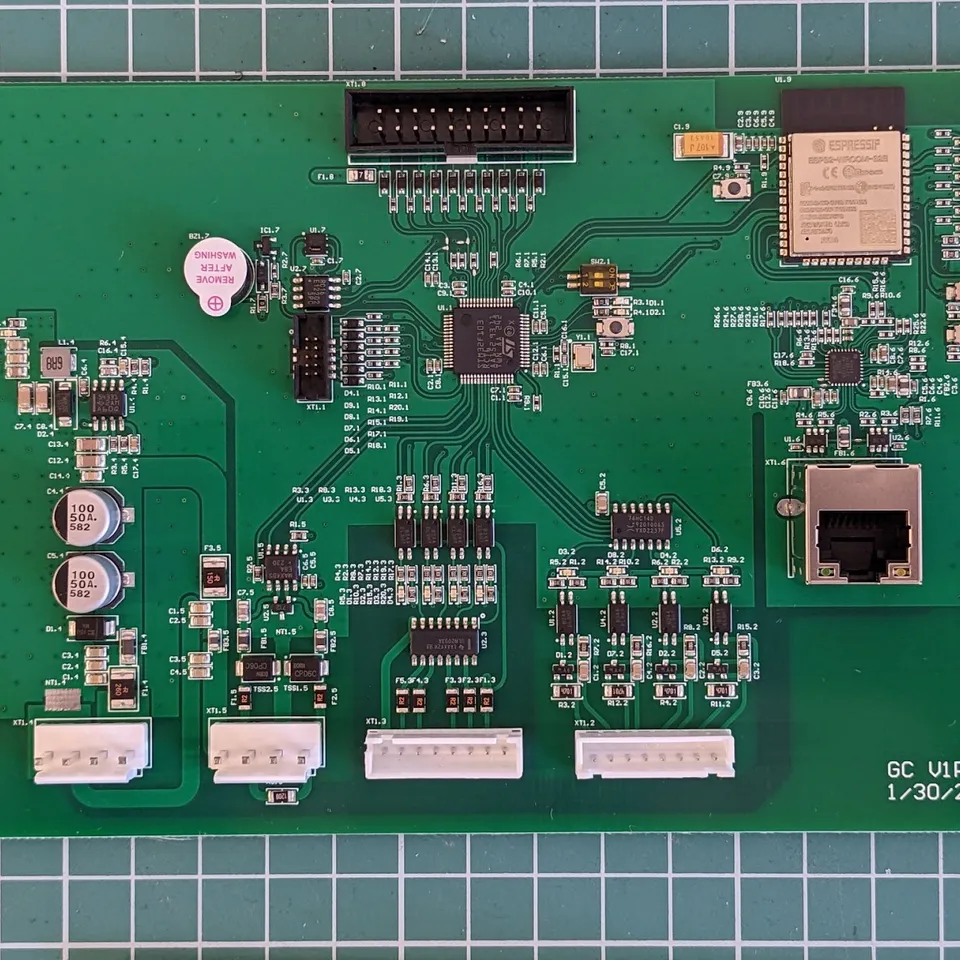
When an off-the-shelf PLC is too large, too costly at volume or cannot do what the machine needs, custom PLC design gives you a controller built for one job. We design controllers, I/O and interface boards, and front panels for cabinets and machines, write their firmware, and test them against the conditions of a real installation.
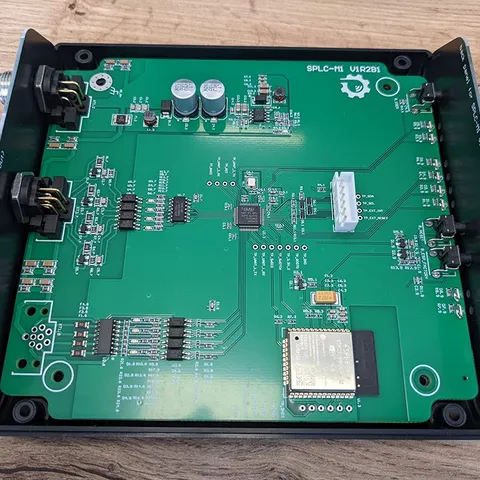
A complete controller in a standard DIN-rail housing, with digital and analog I/O, relay outputs, a 24 V supply input and pluggable terminals.
Extra inputs and outputs for an existing controller, over RS-485, CAN or a local bus.
Converters between serial, Ethernet and wireless networks, such as RS-485 to Ethernet or Modbus to a cloud service.
Boards with LED or seven-segment displays, OLED screens, buttons and encoders, mounted in a cabinet door or panel.
Controllers built around STM32 or ESP32 microcontrollers, with Ethernet or Wi-Fi for remote access.
A controller in a cabinet sits next to contactors, motor drives and long field cables. Our industrial controller design accounts for that from the first schematic:
A Modbus RTU device is still the most common thing we build for industry, and we design for the other links a cabinet uses too:
Protocol firmware is written and tested with the hardware, see embedded firmware.
A project can start from a controller already in service: a board that is no longer made, a PLC that is too expensive at volume, or a design nobody can support. We can match the existing terminals, mounting and register map, so the new controller drops into the cabinet without rewiring, and integrators and SCADA systems keep talking to it as before.
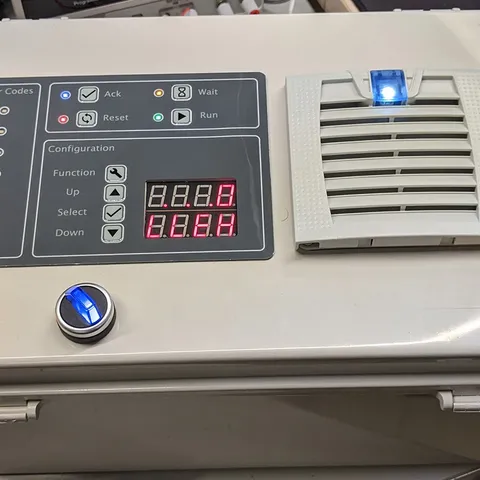
Industrial control equipment sold in the EU falls under the EMC Directive and, above 50 V AC or 75 V DC, the Low Voltage Directive. We design to the immunity levels of the EN 61000 series for industrial environments, and to IEC 61010-1 safety requirements for control and laboratory equipment where they apply. Pre-compliance checks are part of compliance testing.
For the controller as a whole. Read more
For the main board, I/O boards and front panel. Read more
For DIN-rail, wall-mount and panel housings. Read more
For terminal blocks, relays and connectors that must hold under vibration. Read more
With fixtures that exercise every input, output and communication port. Read more
Design source, manufacturing files, firmware source and binaries, a register map or protocol description for integrators, wiring drawings and test procedures. Prototypes are delivered assembled in their housings and tested.